

SEO for HVAC contractors is the step-by-step work of getting your heating and cooling business to appear on Google Search and Maps when nearby customers look for repair, installation or maintenance.
HVAC demand swings with the weather. A heat wave or a cold snap fills the phone, and then the shoulder seasons go quiet. Search helps on both sides, because people type a problem and a city when they are ready to book.
This guide walks through the setup in order. It covers the profile, the pages, the code, the reviews and the tracking. It applies to residential and commercial HVAC contractors in Canada and the US.
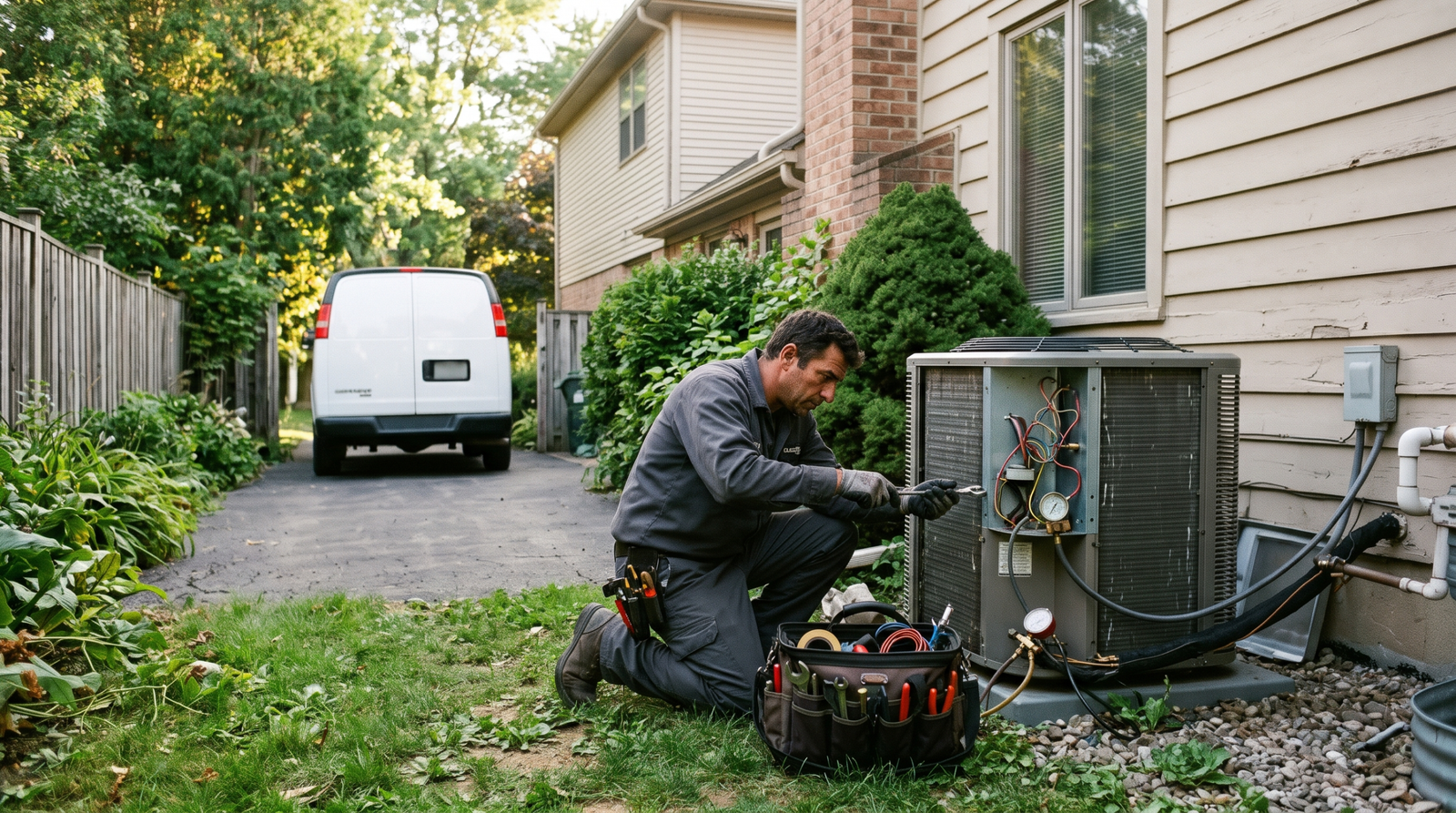
Why SEO for HVAC contractors is worth the effort
The trade is growing. The US Bureau of Labor Statistics counts 440,900 HVAC mechanic and installer jobs in 2025. It also projects 11 percent growth from 2025 to 2035. So more work is coming, and more competitors are coming with it.
Equipment is changing too. In Canada, the Canada Energy Regulator reports that heat pumps rose from 238,000 units in 2000 to 1,335,000 in 2023. As a result, customers are searching for systems they have never bought before.
In addition, customers check before they call. BrightLocal’s 2026 Local Consumer Review Survey of US consumers found that 97 percent read reviews for local businesses. Therefore, being visible and well reviewed matters more than being cheapest.
How to set up SEO for HVAC contractors, step by step
Work through these six steps in order. Each one builds on the one before.
Step 1: Claim and complete your Google Business Profile
First, verify your profile. Google’s local ranking guidance explains that local results weigh relevance, distance and how well known a business is. Then fill in every field: primary category, service area, hours, services and photos of real installs. Our Google Business Profile optimization checklist lists each field.
Step 2: Map services to the words customers type
Next, write down every service you want more of. Then note how a customer would search for it. These phrases are your keywords. Split them by season, because HVAC searches shift through the year.
| Service | Example keyword | Busy season | Page to build |
|---|---|---|---|
| AC repair | ac repair + city | Summer | AC repair page |
| Furnace repair | furnace repair + city | Winter | Furnace repair page |
| Heat pump installation | heat pump installation + city | Spring and fall | Heat pump page |
| Maintenance plans | hvac maintenance + city | Spring and fall | Maintenance plan page |
| Commercial service | commercial hvac + city | All year | Commercial page |
Step 3: Build one page per service
After that, give each service its own page. Put the keyword in the page title, the first sentence and one heading. Google’s guide to title links recommends titles that are descriptive and concise. Also add photos, brands you service, the areas you cover and a phone button. For layout ideas, see our contractor website design guide.
Step 4: Add your business details in code
Then add schema to your site. It labels your name, address, phone number and hours in a format Google can read. According to Google’s LocalBusiness documentation, name and address are the required properties. Our local business schema markup guide gives the steps.
Step 5: Ask every customer for a review
Reviews help you stand out. Google’s guidance says more reviews and positive ratings can help local ranking. So text a review link the day a job is finished. In addition, BrightLocal found that 74 percent of consumers only care about reviews written in the last three months. Therefore, a steady trickle beats one big push.
Step 6: Publish ahead of the season
Finally, publish seasonal pages early. New pages need time to rank. So post furnace content in late summer and cooling content in late winter. Meanwhile, list the business on trusted directories with matching details, and seek backlinks from suppliers and trade associations.

How to measure SEO for HVAC contractors
Rankings are a signal, not a result. Instead, track calls and booked jobs.
- Search Console: shows which searches display your site and how many people click. Start with Google Search Console for contractors.
- Profile insights: shows calls, direction requests and website clicks from your profile.
- Call tracking: shows which page or listing made the phone ring. See phone call tracking for contractors.
- Booked jobs: ask every caller how they found you and log it.
Here is an example with illustrative numbers only. Suppose you spend $2,000 CAD (about US$1,440) a month on SEO work. If search brings 25 enquiries that month, your cost per lead is $2,000 divided by 25. That is $80 CAD, or about US$58. Then compare it with your other sources.
Common mistakes with SEO for HVAC contractors
- Putting heating and cooling on one page, so neither matches a specific search.
- Publishing seasonal pages after the season has started.
- Listing a service area far wider than the crews can reach.
- Asking for reviews once a year instead of after every job.
- Judging SEO for HVAC contractors by rankings alone and never counting calls.
If you would prefer help, our construction SEO service runs this whole routine. For the wider plan, read HVAC contractor marketing.
Plain-English glossary
Tap any term below for a simple explanation.
SEO (search engine optimization)
The work of making your website and listing show up higher on Google when people search for what you do. You do not pay Google for these spots.
HVAC (heating, ventilation and air conditioning)
The trade that installs and services furnaces, air conditioners, heat pumps and ventilation.
Google Business Profile
Your free business listing on Google Search and Maps. It shows your phone number, hours, photos and reviews.
Local ranking
The order in which Google lists nearby businesses. It depends on how well you match the search, how close you are and how well known you are.
Keyword
The words a customer types into Google, such as furnace repair plus a city name.
Service page
One page on your website about one service. It gives Google a clear page to show for that search.
Page title
The headline of a page that shows as the blue link in Google results.
Schema
A small piece of code that labels your business details so Google can read them without guessing.
Directory listing
Your business entry on a site that lists companies. Matching details across listings help Google trust them.
Backlink
A link from another website to yours. Google treats good ones like a vote of confidence.
Search Console
A free Google tool that shows which searches display your website and how many people click.
Call tracking
Special phone numbers that record which page, ad or listing made the phone ring.
Cost per lead
What you paid for each enquiry. Divide what you spent by the number of enquiries; $2,000 for 25 enquiries is $80 each.
Where Brand Builds fits
We set up and run search for HVAC and other trade contractors through our construction SEO service, and we report on calls and booked jobs. Plans start at $2,100 CAD a month, about US$1,500, as listed on our pricing page. To see where your listing and pages stand today, book a free marketing audit.
Frequently asked questions
It is the work of making your heating and cooling business show up on Google Search and Maps when local customers look for your services, without paying for each click.
Profile updates and new reviews can help within weeks. New service pages usually take a few months to rank, so publish seasonal pages well ahead of the busy period.
Yes. One page per service gives Google a clear match for each search, and it lets you speak to the problem the customer has that day.
There is no fixed number. Aim for a steady flow of recent reviews, since BrightLocal found most consumers only care about reviews from the last three months.
Both can work. Ads bring calls quickly while you pay. SEO takes longer but keeps bringing enquiries without a cost for each click.

