

Construction public relations is the work of earning coverage, awards and third-party mentions so that owners, architects and buyers trust your firm before they ever speak to you.
Most construction firms treat PR as a press release sent after a ribbon cutting. I think that is the wrong job. In my view, PR exists to produce proof that someone else was willing to publish.
This article explains where that proof fits, what editors want and how to run a simple programme. It applies to contractors, builders, manufacturers and design firms in Canada and the US.
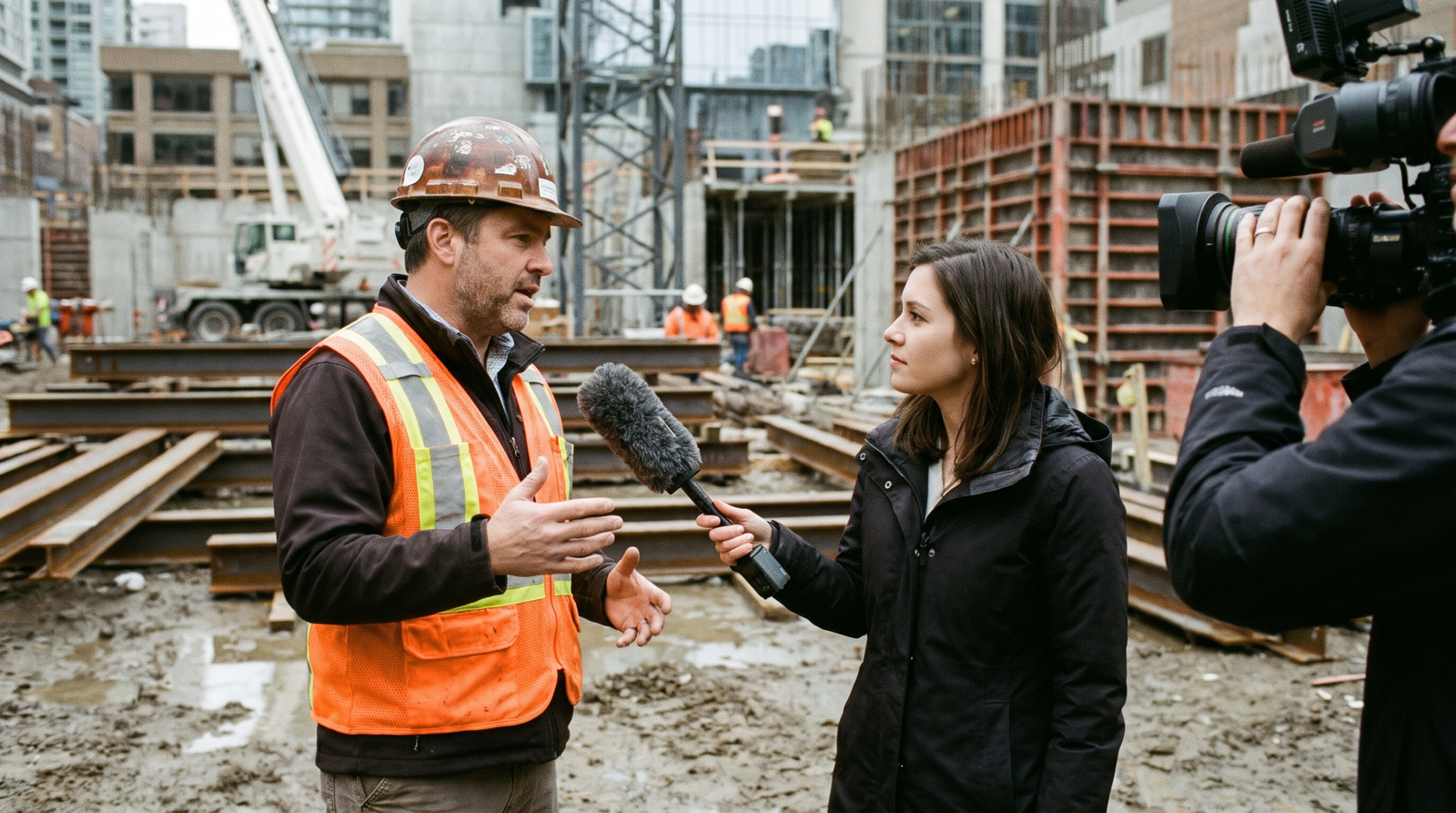
Why construction public relations is a trust problem, not a publicity problem
Construction is a large and cautious market. The US Census Bureau put construction spending at a seasonally adjusted annual rate of $2,186.1 billion in September 2026. Buyers who commit that kind of money do not take a supplier’s word for it.
In addition, trust in companies is limited. The 2026 Edelman Trust Barometer found that 64 percent of the general population across 28 countries trusts business. So roughly a third of your audience starts out doubtful. That survey covers all industries, not construction alone.
Therefore, your own website can only do part of the work. A buyer discounts what you say about yourself. However, the same buyer gives weight to a trade magazine feature, an award shortlist or an association panel. That gap is why construction public relations matters.
Where PR fits: specified, invited, chosen
We sort every construction sale into three moments. A product gets specified. A firm gets invited to bid or propose. Then one company gets chosen. PR helps at each moment, but in different ways.
| Moment | Who decides | What PR should produce |
|---|---|---|
| Specified | Architects, engineers, designers | Technical articles, product features and continuing education mentions |
| Invited | Owners, developers, general contractors | Project features, award shortlists and speaking slots |
| Chosen | Selection committees and homeowners | Recent coverage and reviews a nervous buyer can verify |
For example, a glazing manufacturer needs editors who reach specifiers. A general contractor, on the other hand, needs regional business coverage that owners read. So the first PR decision is not which story to tell. Instead, it is which moment you are losing. Our guide to construction industry marketing explains the framework in full.
What editors want, according to journalists
Most pitches fail for a simple reason. They are written for the sender. Two 2026 surveys show how wide the gap is, although both cover journalists in general and not the trade press alone.
Relevance beats volume
Muck Rack’s State of Journalism 2026 analysed responses from 897 journalists. It found that 86 percent say at least some of their stories start with a PR pitch. Yet 88 percent immediately disregard pitches that miss their beat.
Similarly, Cision’s 2026 State of the Media report surveyed 1,899 journalists. In that survey, 72 percent said fewer than a quarter of the pitches they receive are relevant. As a result, a short list of the right editors will outperform a blast to five hundred.
Short, direct and useful
The same Muck Rack report found that 62 percent of journalists prefer a one-to-one email. Also, 69 percent prefer pitches under 200 words. So write to one person, lead with the news and attach what they need.
The stories construction firms really have
Firms often tell me they have nothing newsworthy. That is rarely true. In fact, most have several stories sitting in project files.
- A hard problem solved: a tight site, a schedule recovered or a detail nobody had built before.
- Data only you hold: lead times, defect rates or cost trends from your own jobs.
- A first: a new material, method or certification in your region.
- People: apprentices trained, a succession plan or a safety milestone.
- A clear opinion: a stance on procurement, codes or tariffs that you can defend.
Notice what is missing. A new website, a new hire and an anniversary are not news to an editor. Meanwhile, a documented project is. That is why strong construction case studies are the raw material for most coverage.

A quarterly rhythm that a busy firm can keep
PR fails when it depends on spare time. So give it a fixed rhythm.
Month one: gather
First, pick one finished project and one opinion. Then collect photographs, numbers and a named client or architect who will comment. Without permission and pictures, the story stops here.
Month two: pitch
Next, choose five to ten editors who cover that building type or region. Send each a short, personal note. If you hear nothing, follow up once. In the Muck Rack survey, 51 percent of journalists said a follow-up should come three to seven days later.
Month three: reuse
Finally, put the coverage to work. Add it to proposals, bid packages and your website. Also share it on LinkedIn and in your newsletter. Coverage that nobody sees again is wasted effort.
Who should own it
Give construction public relations one named owner. That person does not need to write everything. However, they must chase photographs, approvals and deadlines. Otherwise, the rhythm slips the first time a bid is due.
What PR cannot do
I would rather be clear about the limits. PR will not fix a weak offer, and it will not produce leads on a schedule. Furthermore, it should not be bought for links.
Google’s spam policies list links with optimized anchor text in press releases distributed on other sites as link spam. So write releases for readers, and treat any link as a bonus. Earned mentions still help people find you, as our piece on construction company AI search explains.
What it costs and how to judge it
Costs vary with scope. As an illustrative example only, suppose a firm sets aside $3,000 CAD (about US$2,160) a month for PR support. Over a quarter, that is $9,000 CAD, or about US$6,480. If the work earns three relevant features, each one cost $3,000 CAD.
That figure means little by itself, though. Instead, judge construction public relations by what it changes at the three moments.
- Did specifiers ask for information after a technical article?
- Were you invited to a shortlist you were not on last year?
- Do proposals now carry outside proof on the first page?
Our construction marketing budget guide shows how to size this spend against the rest of the plan.
Where Brand Builds fits
We plan and run construction public relations through our PR and outreach service, alongside content marketing that supplies the stories. Plans start at $2,100 CAD a month, about US$1,500, as shown on our pricing page. To see which moment your firm is losing, book a free marketing audit.
Frequently asked questions
It is the work of earning coverage, awards and mentions from outside sources so that owners, architects and buyers trust a construction firm before the first meeting.
It can be, if you have documented projects and a clear local angle. Start with one regional outlet and one trade publication before spending on anything larger.
Advertising is paid space that you control. PR is coverage an editor chooses to run, so you control less but readers tend to trust it more.
Expect a quarter before the first coverage appears, because editors plan ahead. The effect on invitations and specifications builds over a year or more.
Not through links. Google treats links with optimized anchor text in distributed press releases as link spam. Releases help when they lead to real coverage.

