

Construction case studies win specs and bids when they prove a product or crew performed on a real project, in the language the architect, contractor or owner needs to defend the decision.
Most case studies do the opposite. They celebrate the company, show one glossy photo, and say almost nothing a specifier can use. We see this across building product manufacturers, millwork shops, hardware brands and trade contractors in Canada and the US. As a result, the page gets published, ignored, and quietly dropped from the sales process.
Here is our point of view. A case study is not a trophy. It is a risk-reducer for a buyer who has to say yes to you in front of someone else.
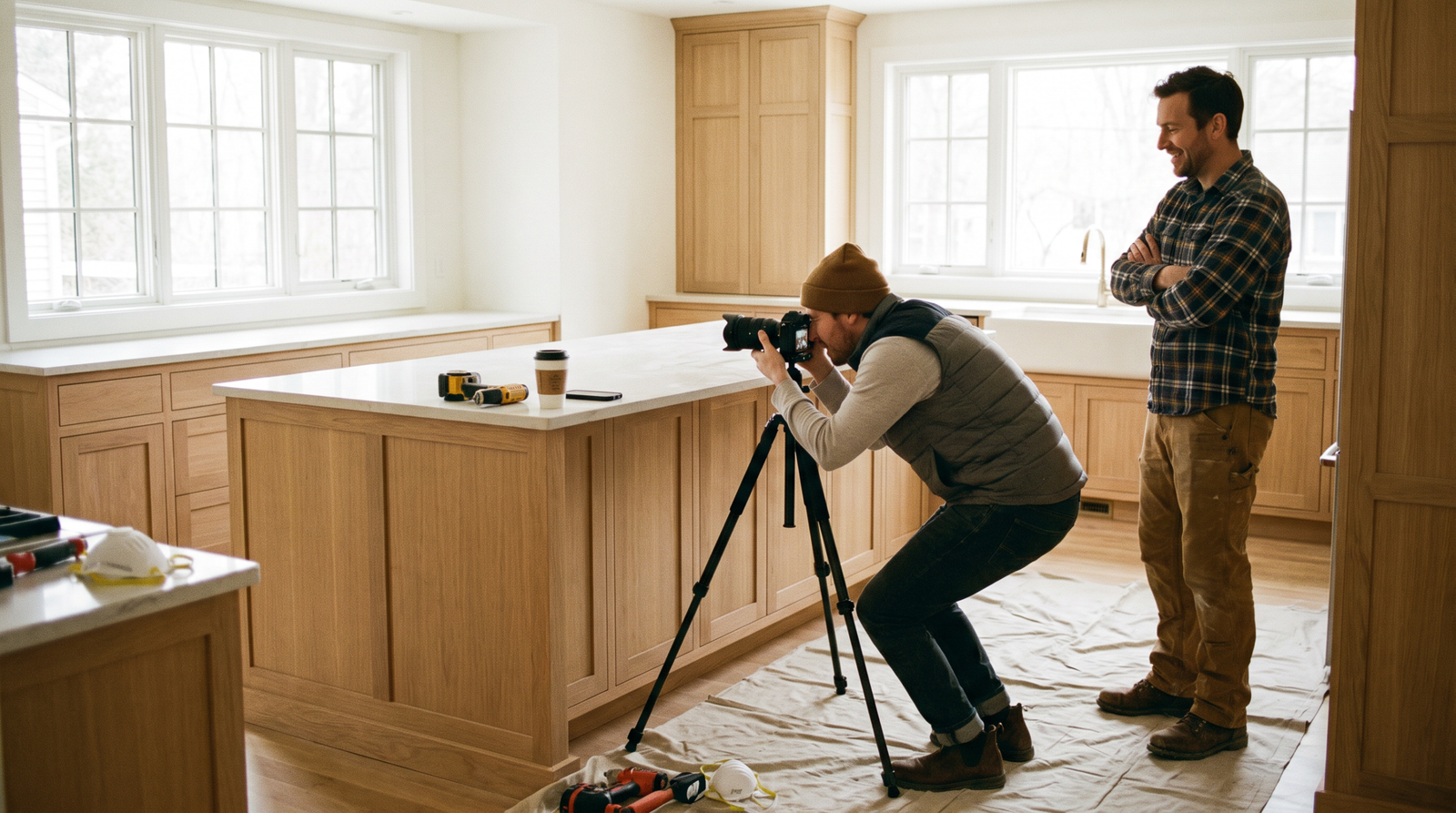
Why construction case studies matter more than your brochure
In construction, almost every buyer is accountable to someone. The architect answers to the owner. The contractor answers to the architect. The purchaser answers to the budget. Therefore, each of them looks for proof that nothing will go wrong on their watch.
We describe this with a simple framework: specified, invited, chosen. First, an architect or designer specifies you. Next, a contractor or dealer invites you to bid. Finally, an owner or homeowner chooses you. A good case study helps at every step, because it answers the question “has this worked somewhere like my project?”
The evidence outside construction points the same way. In a 2026 survey of 600 B2B software buyers, 88% said it is at least somewhat important that a product story helps them envision success after implementation, and 53% said it is very important (Arcade buyer trust survey). That survey covers software, not building products. Even so, the buying psychology of proof carries over to any high-stakes purchase.
What a specifier looks for
An architect scanning a case study asks four questions. What was the project type and scale? What problem did the product solve? Was it installed as designed? Did anything go wrong, and how was it handled? If your page answers those four, it earns a place in their research file.
What every construction case study needs
Use the same structure each time. Consistency lets your sales team find the right proof quickly, and it lets buyers compare projects at a glance.
| Section | What to include | What to avoid |
|---|---|---|
| Project snapshot | Location, building type, scale, completion date, team credits | Vague labels like “a large project” |
| The challenge | The design, schedule or performance problem | Generic claims about quality |
| The solution | Which product or scope was used, and why it was chosen | A product brochure in disguise |
| The result | Outcomes you can prove: lead time met, installation completed, issues resolved | Numbers you cannot back up |
| Downloads | Spec sheet, details, installation notes | Gated forms that block the specifier |
Credit everyone on the project
Name the architect, contractor, installer and owner where they agree to it. Credit builds goodwill, and it helps the next buyer picture their own team on the job. In addition, people share pages that mention them. Always get written permission first.
Use only results you can prove
This is where many firms slip. Do not round numbers up. Do not invent a quote. If the client did not measure energy savings or time saved, do not claim them. Instead, state what you know: the product was delivered on the promised date, the install matched the drawings, or the finish passed the owner’s walk-through. Honest, specific proof beats an impressive claim every time.
Google’s own guidance on helpful content asks whether a page demonstrates first-hand expertise and depth of knowledge, and it stresses that trust is the most important quality (Google Search Central). A case study written from real project knowledge fits that standard well.
How to gather the proof without chasing clients
The biggest barrier is not writing. It is collecting facts after the project ends, when everyone has moved on. So build the process into the job itself.
- Flag projects worth documenting at the start, not the end.
- Ask the client for permission to feature the project in your contract or kickoff.
- Photograph progress, not just the finished result.
- Save drawings, product schedules and key emails as the job runs.
- Book a 15-minute call with the architect or contractor after completion.
- Draft the page within two weeks, while the details are fresh.
Notably, step five is the one most teams skip. A short call gives you the context, the challenge and a quote you can actually attribute.

Photos and video decide whether anyone reads it
Construction is visual, and specifiers judge quality by the image before they read a word. Hire a professional photographer for your best projects, and shoot the details a designer cares about: joints, edges, finishes and how the product meets other materials.
Google advises placing images near relevant text and writing descriptive alt text, which is also good for accessibility (Google Search Central: image best practices). Therefore, name your files clearly and describe what the image actually shows. If you want motion as well, see our work on construction video production.
Where to publish and how to put the case study to work
Publishing the page is only the start. Treat each case study as a sales asset that you reuse in several places.
- Link it from the matching product or service page, so proof sits next to the claim.
- Send it to architects and dealers as a follow-up after a lunch-and-learn or quote.
- Add the project to your Google Business Profile, if you serve a local market.
- Turn it into a short LinkedIn or Instagram post with one strong photo.
- Attach it to proposals and bid packages.
For manufacturers, this ties directly to the work of getting written into the spec. Our guide to product specification marketing and our post on marketing to architects show how proof supports each step. Likewise, building product manufacturer marketing explains why firms lose specs without it.
Match the case study to the buyer
Write at least one version for each buyer type. An architect wants performance and details. A contractor wants lead times and installation ease. An owner wants the finished result and the experience of working with you. Our post on architectural hardware marketing shows how that plays out when the designer is the real buyer.
Where Brand Builds fits
Brand Builds plans, writes and publishes construction case studies as part of our content marketing service, so your best projects keep working for you. Plans start at $2,100 CAD a month, about US$1,500, and you can see all options on our pricing page. To find out which of your projects deserve a case study first, book a free marketing audit.
Frequently asked questions
Include a project snapshot, the challenge, the solution, a result you can prove, team credits and downloadable documents such as spec sheets. Keep the structure the same on every page.
Most work well at 400 to 800 words with strong photos. Length matters less than whether it answers the questions a specifier or contractor will ask.
Yes. Get written permission from the owner, and from the architect or contractor if you name them. Build the request into your contract or kickoff so it is easy to obtain.
Use facts you can prove instead, such as delivery on the promised date, installation matching the drawings or a passed walk-through. Never invent or round up results.
Start with three to five covering your main project types, then add one after each strong project. A small set of well-made pages beats a long list of thin ones.

