

Building product marketing works when you stop treating it as one budget for one audience and split it across the three buyers who decide your fate: the specifier who names you, the dealer or contractor who invites you, and the end buyer who chooses you.
Most manufacturers do the opposite. They spread a single budget thinly across trade shows, a catalogue and a website, then wonder why none of it compounds. In my view, that is the core mistake in the category.
This article sets out how I would divide the effort. It applies to makers of windows, doors, hardware, glass, cabinets, cladding and similar products in Canada and the US. It also uses figures from published architect research, so you can see where the pressure sits.

Why building product marketing is really three jobs
A product sale in construction rarely has one decision maker. Instead, a chain of people each say yes before money moves. At Brand Builds we describe that chain as specified, invited, chosen.
- Specified: an architect, designer or engineer writes your product into the drawings or the spec.
- Invited: a contractor, builder or dealer puts you on the bid list or the approved-supplier shortlist.
- Chosen: the homeowner, installer or purchasing manager picks you from the options in front of them.
Each stage needs different marketing. Moreover, a failure at an early stage cannot be fixed later. If nobody specifies you, a great dealer program has little to sell.
Stage one: win the specifier
Building product marketing starts here, because specifiers decide earliest, so they deserve the most careful work. The numbers show how they behave. The American Institute of Architects found in The Architect’s Journey to Specification 2018, a survey of 400 architects, that the average architect visits about 47 manufacturer websites a year. The same report found that 74 percent will leave a site if they cannot find what they need within a few clicks (AIA report).
That second figure is the one to remember. When architects cannot find information, 61 percent move to a different manufacturer’s site. Your competitor benefits from every gap on your pages.
What a specifier-ready website holds
- Downloadable specification sheets, drawings and installation details.
- Performance data and certifications in plain view.
- Finished project photos with the architect credited, where permitted.
- A named contact who answers quickly.
Proof matters as much as data. An ArchDaily survey of 585 professionals from 83 countries found that 89 percent expect technical data directly on manufacturers’ websites, and 91 percent said seeing a product successfully applied in another project is the most important factor in choosing a supplier (ArchDaily report, 2020). That survey is international, so treat it as a signal, not a Canadian or US average.
For deeper tactics, see our guides on product specification marketing and marketing to architects.
Stage two: earn the invitation
Next come the people who buy on behalf of someone else. Contractors, builders and dealers do not pick the product you were specified for. However, they decide whether you are easy enough to quote, deliver and support.
The AIA research points to the same issue with your own people. It reports that 91 percent of architects say rep responsiveness is very important, yet only 36 percent are satisfied with it. Slow replies lose invitations as well as specs.
What the invitation stage needs
- A fast quote process with a clear owner for every enquiry.
- A dealer or contractor portal with pricing, lead times and files in one place.
- Training material that helps installers say your product name correctly.
- Follow-up that does not rely on one salesperson’s memory.
Our guide to building material distributor marketing covers the distributor side in more detail.
Stage three: be the easy choice
Finally, someone picks a product from a shortlist. At this point, brand recognition, reviews, availability and a clear next step do the work. A homeowner choosing windows has usually heard of two or three brands. If yours is one of them, you start ahead.
Content helps here too. Buying guides, comparison pages and installation videos answer questions before a salesperson is involved. Consider your content marketing and your branding as long-term assets for this stage.
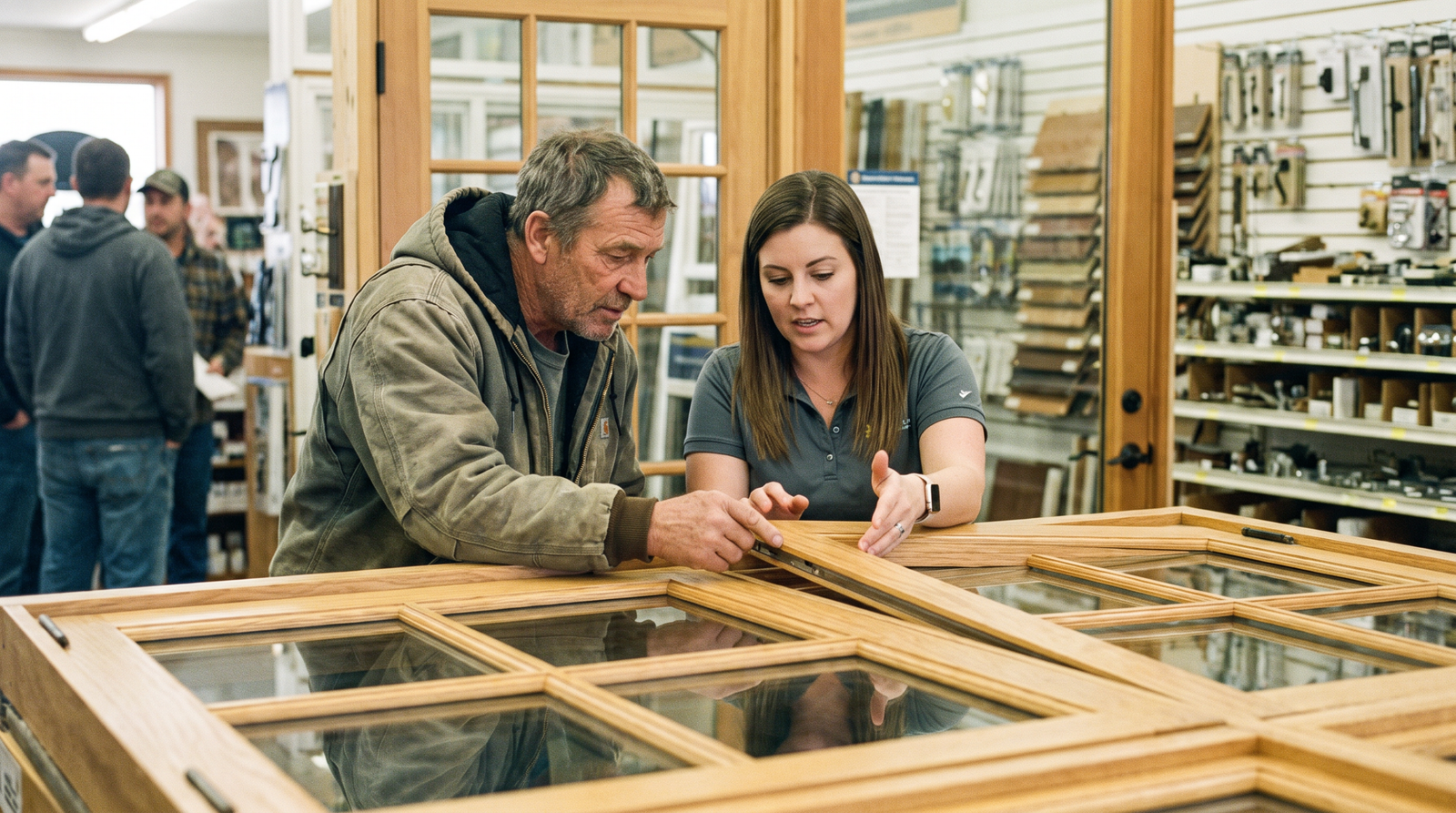
A sample budget split
Good building product marketing is a budgeting discipline before it is a creative one. Decide who you need to reach, then fund each group on purpose.
There is no universal formula. Still, an example helps you think. Imagine a manufacturer with $10,000 CAD a month to spend, about US$7,200. This is an illustration, not a benchmark.
| Stage | Share | Monthly (CAD) | Approx. USD | Typical spend |
|---|---|---|---|---|
| Specified | 40% | $4,000 | $2,880 | Spec content, project photography, website, rep tools |
| Invited | 30% | $3,000 | $2,160 | Dealer portal, quote workflow, training, email |
| Chosen | 30% | $3,000 | $2,160 | Search, reviews, buying guides, video |
Adjust the split to your sales model, your lead times and your margins. Review it each quarter, and move money toward the stage that is producing the most real enquiries. Small, steady changes beat dramatic annual overhauls. A company that sells mostly through dealers may move more money to the second row. A premium architectural brand may lean harder on the first.
How to check it is working
Building product marketing only earns more budget when you can prove it. Therefore, measure each stage separately. For specifiers, track spec sheet downloads and project enquiries. For invitations, track new dealer accounts and quote turnaround. For the final choice, track branded searches and direct enquiries. Without this, you cannot tell which stage is leaking.
Common mistakes I see in building product marketing
- Selling to everyone with one message. A specifier and a homeowner care about different things.
- Hiding technical data behind a form. It adds a click that 74 percent of architects will not tolerate.
- Treating the website as a brochure. It is your busiest sales rep, so equip it.
- Ignoring follow-up. Interest fades quickly without a system.
If you want a wider view of the category, read our overview of building product manufacturer marketing. You can also see how we work with manufacturers on the how we work page.
Where Brand Builds fits
Brand Builds is a marketing agency for building product makers, and our building products marketing agency service covers all three stages. Plans start at $2,100 CAD a month (about US$1,500), as shown on our pricing page. To see where your budget leaks, book a free marketing audit.
Frequently asked questions
Building product marketing is the work of getting construction products specified, stocked and bought. It covers architects and designers, dealers and contractors, and end buyers, each of whom needs different content.
There is no fixed rule. Start from your sales goals and your margins, then split the budget across the specifier, dealer and buyer stages and review the split every quarter.
In the AIA 2018 survey, 74 percent said they leave if they cannot find what they need within a few clicks. Missing spec sheets and poor navigation are common causes.
Yes. Specifiers, dealers and end buyers behave in similar ways on both sides of the border, although codes, certifications and dealer structures differ by region.
Start with the specifier stage. Build a clear product page with downloadable spec sheets and project photos, then add a fast quote process before you spend on wider campaigns.

