

Construction company branding is the set of visible and verbal signals that tell an owner, architect or general contractor you are the safe choice before they ever call.
Most construction firms treat branding as a logo and a truck wrap. However, buyers read far more than that. They read your website, your job photos, your name on Google and the way your crew shows up. In this article, I explain what branding does in construction, where it earns money, and how to build it without a big agency budget.
I have watched the same pattern across building product, millwork, glass and trade clients. The firm with the clearer story wins the close call, even when the price is slightly higher. That is the whole argument for branding, and it is why I treat it as a sales tool rather than decoration.

Why construction company branding decides close calls
Construction buyers carry real risk. A bad contractor means delays, cost overruns and legal headaches. As a result, they look for proof that you are stable, skilled and easy to work with. Your brand supplies that proof in seconds.
I use a simple framework for this: specified, invited, chosen. A firm gets specified when an architect or engineer names it in the drawings. A firm gets invited when it lands on a bid list. A firm gets chosen when the owner picks it from the final two or three. Branding works at every stage, but it matters most at the second and third.
Specified: the designer needs to trust you
Architects and designers put their own reputation behind the names they write down. Therefore, they look for firms that appear credible, consistent and current. A dated website or a blurry project gallery quietly removes you from the shortlist.
Invited and chosen: the owner needs a reason
Once you are on a bid list, price is only one input. Owners also ask who will answer the phone, who will manage the site and who will fix a problem in year two. A clear brand answers those questions before anyone asks them.
The five parts of a construction brand
Construction company branding sounds abstract, so I break it into five parts you can inspect today. Each one has a plain test.
| Part | What it covers | Quick test |
|---|---|---|
| Name and positioning | Who you serve and what you do best | Can a stranger repeat it after ten seconds? |
| Visual identity | Logo, colours, type, truck, uniforms, signs | Do all of them look like the same company? |
| Proof | Photos, case summaries, reviews, certifications | Is every claim backed by something visible? |
| Voice | How you write quotes, emails and your website | Does it sound like a person, not a brochure? |
| Experience | Response speed, site tidiness, communication | Does it match what the website promised? |
Notice that only the second part is about design. The other four are about clarity and behaviour. Consequently, you can improve most of your brand without touching your logo.
Start with positioning, not a logo
Positioning is the sentence that says who you are for. For example, a firm that says it builds everything for everyone sounds like every other firm. In contrast, a firm that says it fits out retail and restaurant spaces on a fixed schedule sounds like a specialist.
Write your positioning in one line using this pattern: we help [type of client] get [result] without [common fear]. Then test it on three past clients. If they nod, keep it. If they hesitate, narrow it.
Pick a lane you can prove
Specialists win trust faster, and they also win better margins. Moreover, a narrow lane makes every other branding decision easier, from the photos you shoot to the keywords you target. Our guide to contractor marketing strategy shows how positioning feeds the rest of your plan.
Make your name consistent everywhere
Inconsistency is the cheapest branding mistake to fix. Your company name should read the same on your website, invoices, social profiles and Google listing. Google says your Business Profile name should reflect your real-world name and should not carry extra keywords or taglines. Breaking that rule can even get a profile suspended.
You can also help search engines connect the dots. Google explains how Organization structured data helps it understand your business name and logo. Our construction SEO work covers this setup so your name and logo stay consistent in results.
Show proof, because proof is the brand
A promise is cheap in construction. Proof is not. For that reason, your best branding asset is a library of real project photos with short captions that name the scope, the location type and the result.
- Shoot every project at the start, middle and finish, using natural light.
- Caption each photo with the scope, the building type and the challenge you solved.
- Ask for a short written review the week you hand over keys.
- Show certifications, safety records and insurance where buyers can find them.
- Put one named person on every project page so the firm feels human.
Never invent testimonials or results. Buyers can smell it, and regulators are paying attention. The FTC now bans fake reviews and testimonials, including paid and AI-generated ones, so only publish what is real.
Build the brand where buyers actually look
Your brand lives wherever buyers meet it. Therefore, put your effort into the places they check first.
Your website
Your site is the main brand asset, because every referral ends there. It should state who you serve in the first screen, show recent work and make the next step obvious. Our page on website design for construction companies explains what a strong build includes, and our post on contractor website cost covers what to budget.
Social profiles
Social platforms act as a second portfolio. According to Pew Research Center, 84% of U.S. adults say they ever use YouTube, 70% use Facebook and 51% use Instagram, based on a survey fielded from January to June 2026. So your buyers are already there. Keep the profile photo, bio and project posts aligned with the rest of the brand.
Vehicles, uniforms and job sites
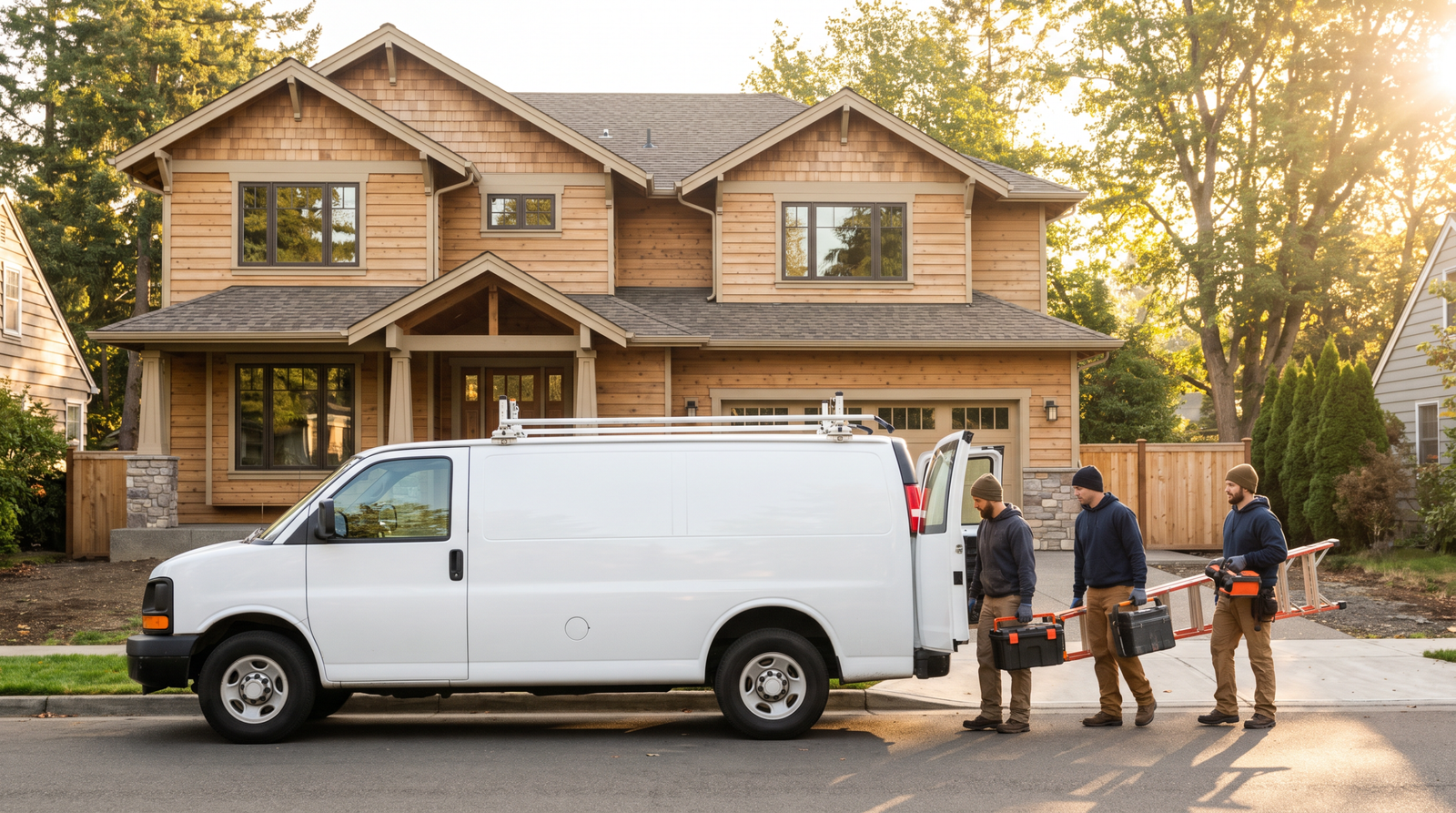
A clean truck and a tidy site are free advertising. Additionally, they signal the same discipline you promise in the contract. Match the colours and logo on every item, and keep the site fenced, labelled and clean.
What branding costs, and how to phase it
You do not need to do everything at once. A sensible order is positioning first, then website and proof, then vehicles and print. Budgets vary widely, so I suggest scoping each phase separately. For ranges and the way we package work, see our branding and design service.
Brand Builds plans start at $2,100 CAD a month, about US$1,500, and branding work can sit inside a plan alongside SEO and content. Review the details on our pricing page. For a wider view of how branding fits next to channels and budgets, read our construction marketing strategy guide, which applies to firms in the US as well as Canada.
How to measure whether the brand is working
Construction company branding feels soft, yet you can still track it. Watch four signals every quarter.
- Direct and branded search: more people type your company name into Google.
- Win rate on invited bids: the share of bids you win rises.
- Average quote size: buyers accept fewer discounts.
- Referral quality: new enquiries arrive already sold on your approach.
If none of these move after two quarters, revisit your positioning before spending more.
Where Brand Builds fits
Brand Builds is a marketing agency for construction, design and hardware companies in Canada and the US. We handle branding through our branding and design service, price it clearly on our pricing page, and you can book a free marketing audit to see where your brand leaks trust today.
Frequently asked questions
Construction company branding is the mix of name, positioning, visuals, proof and behaviour that makes buyers see your firm as credible and low risk.
Yes. A small firm competes on trust, so a clear name, consistent look and real project photos help it win close calls against bigger competitors.
Fix positioning first. Decide who you serve and what you do best, then make your name, website and Google listing say the same thing.
Expect a few months. Consistent changes show up first in branded searches and bid win rates, and the effect grows as you add more real project proof.
No. Branding is who you are and what buyers believe about you, while marketing is how you reach buyers. Strong branding makes every marketing channel work harder.

